Why Is Recovery Between Workouts More Important as You Age?
The science of what happens on your rest days — made simple.

Here’s a truth that surprises many people trying to get fitter after 50: the workout is only part of the process. A lot of the adaptation happens afterward, while your body recovers.
And as we age, that recovery time can become more important — and sometimes a little longer.
So if you’ve ever felt guilty about taking a rest day, or wondered why you don't bounce back quite as quickly as you once did, let's look at the genuinely fascinating science of recovery — in plain English — and why it can be one of your best fitness tools.
💡 First, the big idea.
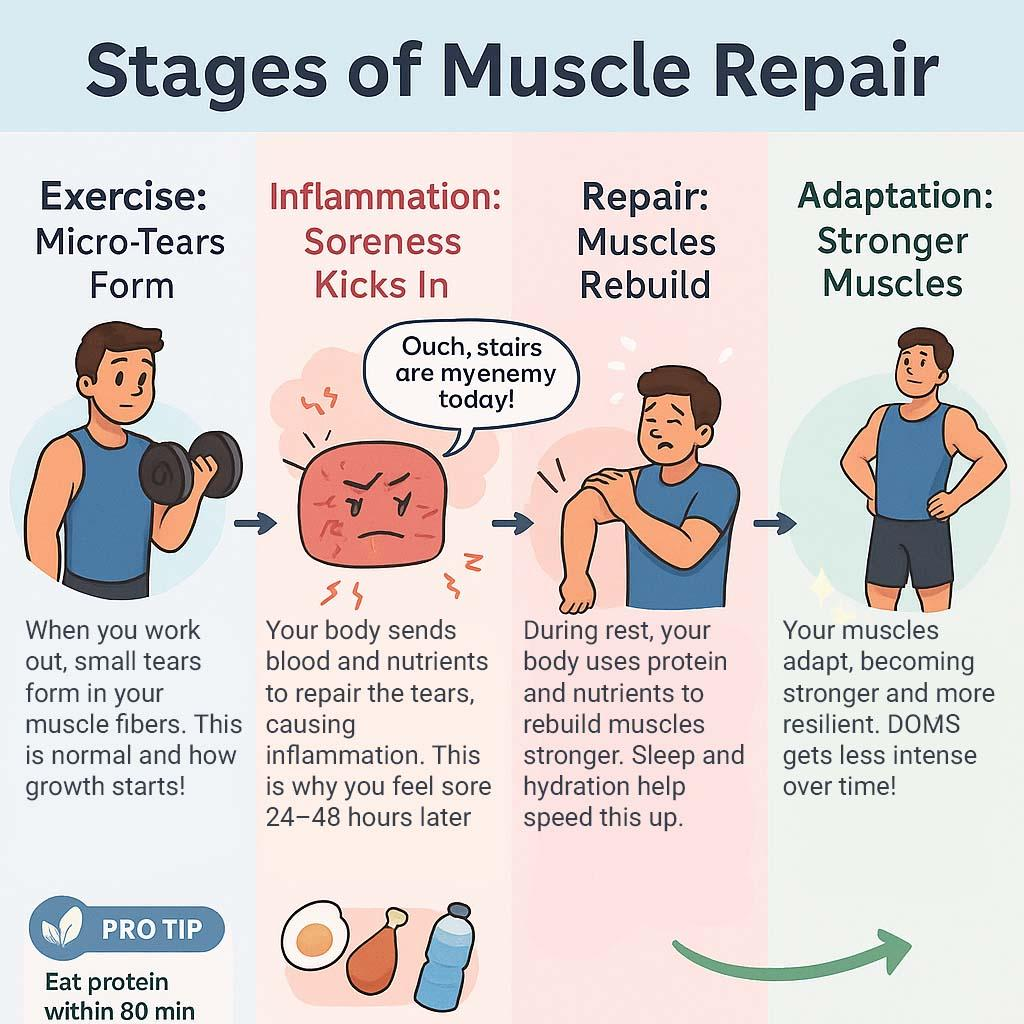
When you exercise, you place your muscles and other body systems under stress. That stress creates a signal that tells your body: adapt to this.
During recovery, your body repairs and remodels the tissues that were challenged and replenishes energy stores. Over time, with appropriate training and nutrition, those adaptations can make you stronger, fitter, and better able to handle the next workout.
So think of it this way:
The workout is the challenge. Recovery is where your body adapts to it.
And this happens at every age.
But after 50, recovery can take longer for some people.
Muscles may repair and adapt more slowly.
As we get older, our muscles become somewhat less responsive to the signals that stimulate muscle protein synthesis — a phenomenon often called anabolic resistance.
That doesn't mean strength training stops working. Far from it.
It means that progressive resistance exercise, adequate protein, sleep, and sufficient recovery become especially valuable for maintaining and building muscle as we age.
Inflammation and soreness can also linger.
Exercise produces a temporary inflammatory response that is part of the body's normal adaptation process. Older adults may experience differences in the inflammatory response and may take longer to feel fully recovered after particularly demanding exercise.
But remember: more soreness does not automatically mean a better workout.
The muscle-building signal changes, too.
After exercise, your muscles receive signals telling them to repair and adapt.
With age, that response can become less robust, particularly when nutrition and exercise aren't supporting it. This is another reason why regular resistance training plus adequate protein becomes increasingly important.
So if you need an extra recovery day compared with your younger self, that isn't necessarily a sign that you're becoming weak.
It may simply mean your training plan needs to match the body you have now, rather than the body you had at 25.
And that's not giving up.
That's smart training.
So what does good recovery actually look like?
Build in recovery between demanding workouts.
You don't necessarily need a complete day of lying on the sofa after every workout. But avoid hammering the same muscle groups hard on consecutive days if they haven't recovered.
You can alternate activities — for example, strength training one day and walking, cycling, mobility work, or another lighter activity the next.
✅️ Prioritize sleep.
Sleep supports a remarkable number of recovery processes, including tissue repair, hormone regulation, immune function, and nervous-system recovery.
There isn't a magic “muscle repair hour,” but consistently getting enough good-quality sleep is one of the most useful things you can do.
✅️ Eat enough protein.
Protein supplies the amino acids your body needs to maintain and repair muscle.
For older adults, spreading protein-containing foods across the day can be a practical way to support muscle maintenance. Think eggs, yogurt, fish, poultry, beans, lentils, tofu, or other protein-rich foods you enjoy.
You don't need to turn every meal into a protein challenge. Consistency matters more than perfection.
✅️ Stay hydrated.
Dehydration can make exercise feel harder and can interfere with normal physical performance. Drink regularly throughout the day, with additional fluids around exercise as needed.
✅️ Try gentle active recovery.
An easy walk, gentle cycling, mobility work, or comfortable stretching can feel better than complete inactivity when you're simply stiff or mildly sore.
But active recovery shouldn't become another hard workout disguised as recovery.
And learn the difference between soreness and pain.
Normal post-exercise muscle soreness tends to develop after a workout and gradually improve.
Sharp pain, significant swelling, worsening pain, joint pain, weakness, or pain that doesn't settle is different.
That's a reason to back off and, if necessary, get professional advice rather than trying to “push through.”

One important correction to the old fitness mindset:
More isn't automatically better.
Doing another hard workout when your body hasn't recovered doesn't necessarily accelerate your results. It can simply leave you fatigued, compromise the quality of your next workout, and increase the risk of overuse problems.
Your goal isn't to see how much exercise you can survive.
It's to find the amount of training you can recover from, adapt to, and repeat consistently.
That's a much more sustainable definition of fitness after 50.
🎯 The honest takeaway:
You don't get stronger simply because you worked hard.
You get stronger because your body responds to that work — and recovery gives it the opportunity to do so.
As we age, muscle adaptation and recovery can become somewhat slower, which makes rest, sleep, adequate protein, hydration, and sensible training increasingly important.
So don't feel guilty about a rest day.
Don't assume soreness means you've done a better workout.
And don't confuse recovery with doing nothing.
Sometimes the smartest thing you can do for tomorrow's workout is to recover properly today.
Your body isn't asking you to stop.
It's asking you to give it time to turn your effort into progress.
— The Daily Wellness Guide