
Why Does Getting Up From a Chair Become Harder With Age?
A simple look at what’s happening in your body — and why it matters more than you’d think.
Here’s a small, everyday moment most of us barely think about: rising from a chair.
When we’re young, we pop up without a thought. But somewhere along the way, many people notice it takes a little more effort — a push on the armrests, a shift forward, a moment to gather momentum.
It seems trivial.
But what's happening inside your body during that moment is genuinely important. The ability to get up from a chair is closely connected with lower-body strength, mobility, balance, and everyday independence.
So let's take a look inside.

💡 What does it actually take to stand up?
Quite a lot, surprisingly.
To rise from a chair, you have to move your body's center of mass forward and then generate enough force through your legs and hips to lift your body upward.
Your quadriceps, glutes, hamstrings, and trunk muscles all contribute, while your ankles and balance system help keep you steady.
In other words, it's essentially a real-life mini squat that you perform several times a day.
And here's why it can become harder with age:
We gradually lose muscle and power unless we keep challenging those muscles.
Age-related muscle loss — called sarcopenia — becomes more common as we get older, and muscle strength and power can decline even faster than muscle size.
That matters because standing from a chair isn't just about having muscle.
It's about being able to produce enough force, quickly and repeatedly.
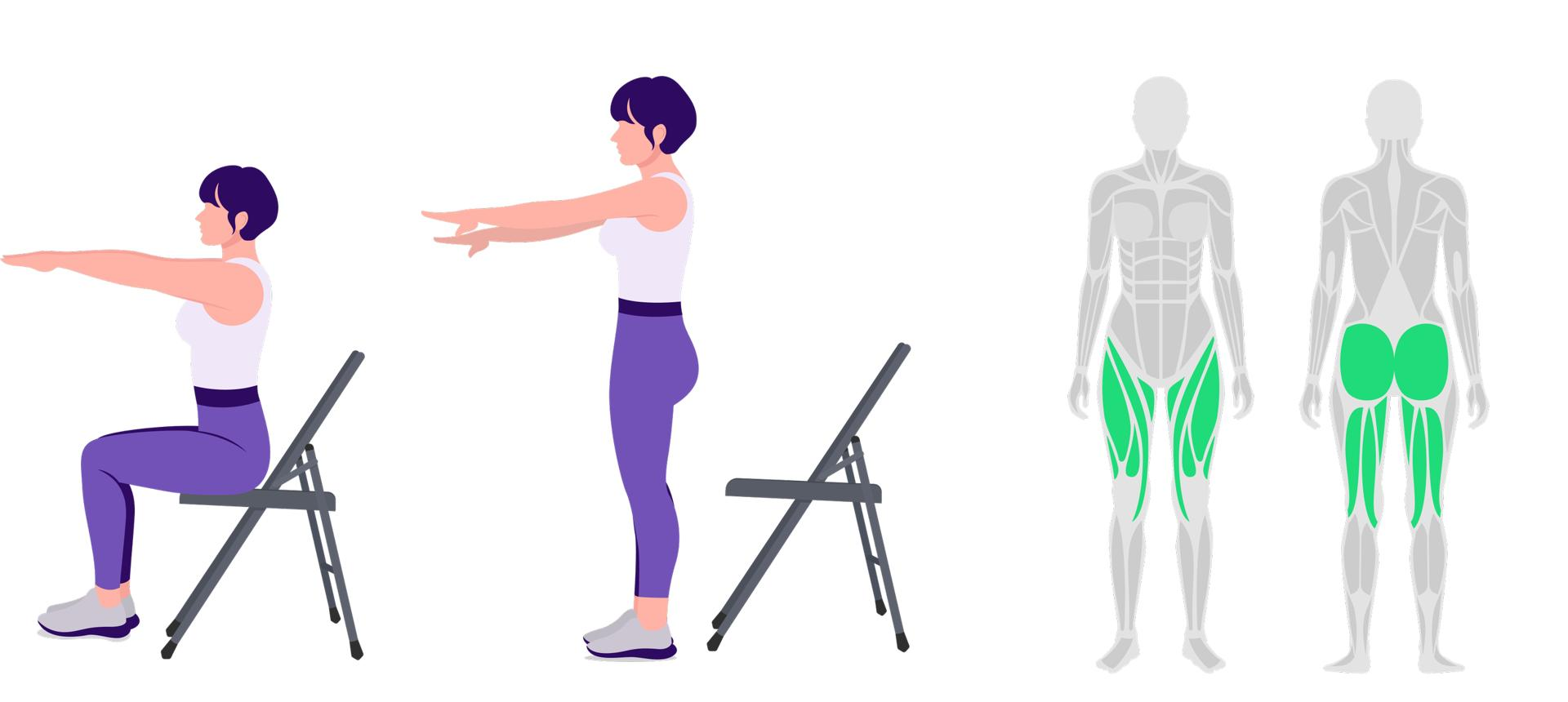
💡 Muscle loss affects the legs.
Your lower-body muscles are doing much of the work when you stand.
Less muscle and less muscular power can mean that the same chair suddenly feels much lower than it used to.
And we often use those muscles less.
Modern life involves an astonishing amount of sitting. If your legs rarely have to squat, climb stairs, carry things, or rise from low chairs, they have fewer reasons to stay strong.
That's the classic “use it or lose it” principle — although fortunately, the reverse is also true:
Use it, and your muscles can adapt.
💡 Why does this little movement matter so much?
Because getting out of a chair isn't just about getting out of a chair.
The ability to rise from a chair is commonly used by health professionals as a practical measure of lower-body strength and functional mobility.
Tests such as the five-times-sit-to-stand test can help clinicians assess physical function and identify people who may need further evaluation.
If you're suddenly struggling to stand, that can be worth paying attention to — particularly if you're also having trouble with stairs, walking, balance, or other everyday activities.
The chair can sometimes tell you something important about your overall physical function.

💡 And here's the wonderful part:
This isn't necessarily a one-way decline.
Muscles respond to resistance and repeated practice throughout life, including in older age.
You don't have to become a gym enthusiast.
You simply need to give your muscles a reason to stay strong.
And one of the most practical ways to do that is almost comically simple:
Practice standing up.
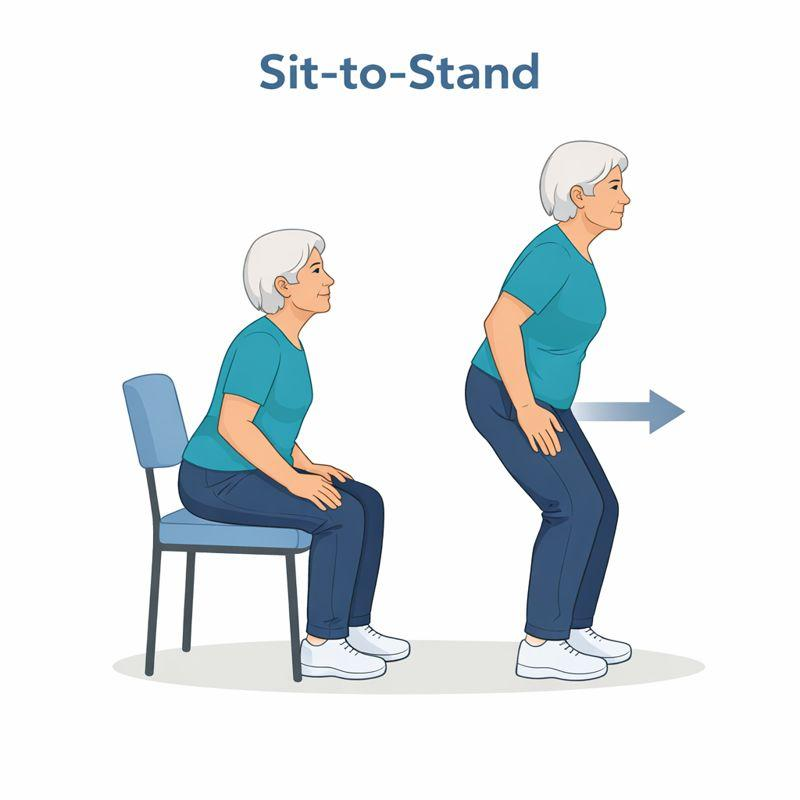
🎯 Try the humble sit-to-stand
Use a sturdy, stable chair that won't slide.
Sit toward the front of the chair with your feet about hip-width apart.
Lean your upper body slightly forward.
Push through your feet and stand up.
Pause and straighten comfortably.
Slowly lower yourself back down.
Repeat at a level that feels manageable.
If necessary, use your hands or a nearby support. The goal is to build strength safely, not to prove you can do it without assistance.
As you become stronger, you can gradually increase the number of repetitions or make the movement more challenging.
Other exercises can help too: heel raises, step-ups, supported squats, and standing marches can all contribute to stronger legs and better function.
If you have significant balance problems, joint pain, or a medical condition that affects exercise, ask a healthcare professional or physical therapist for guidance.
And remember:
Mild muscle fatigue is one thing. Sharp or persistent pain is another.
⚠️ One important thing to watch for
If getting out of a chair has recently become much harder, don't automatically assume it's simply aging.
New or rapidly worsening weakness can have many causes, including medication effects, neurological problems, joint conditions, illness, or loss of conditioning.
And if weakness appears suddenly — especially on one side — or comes with difficulty speaking, facial drooping, severe dizziness, or other sudden neurological symptoms, seek emergency medical care.
For gradual changes, a doctor or physical therapist can help determine whether you're dealing with ordinary deconditioning, age-related muscle loss, or something else that deserves attention.
📝The honest takeaway:
Getting up from a chair looks ordinary, but it's actually a mini test of strength, power, balance, and coordination. As we age, muscle mass and especially muscle power can decline — particularly if we're not regularly challenging our legs.
But here's the empowering part:
Your muscles remain responsive to training.
Practice sit-to-stands. Walk regularly. Climb stairs when appropriate. Strengthen your legs and hips. Keep challenging your body in ways that are safe and sustainable.
And the next time you stand up from your chair, notice what you're doing.
You're not just getting up.
You're using the strength that helps you walk, climb, balance, and stay independent. Every stand is a small investment in your freedom.
— The Daily Wellness Guide